
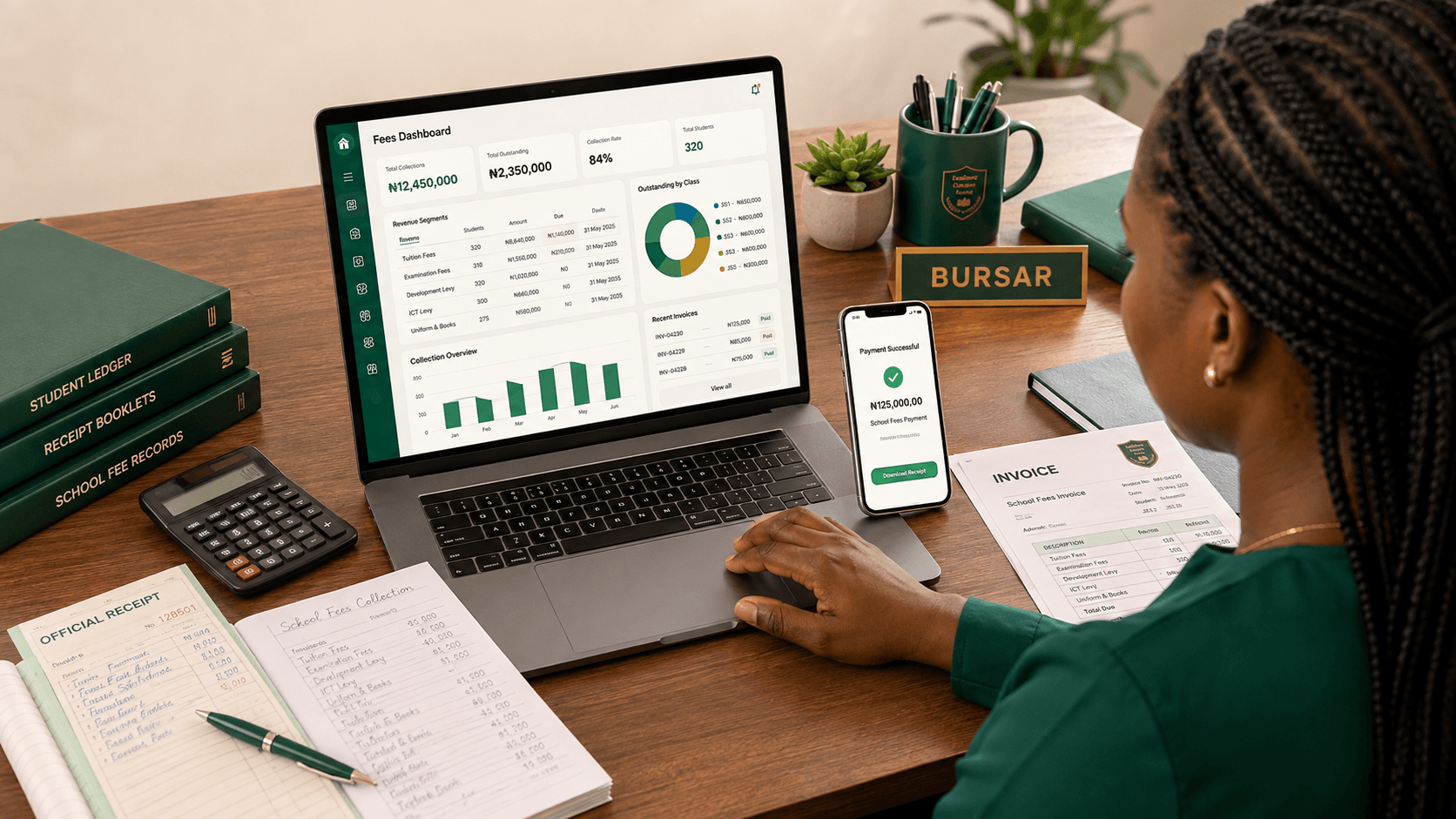
At 8:17 p.m., a parent pays ₦75,000 into the school's bank account.
She sends a screenshot to the school WhatsApp number:
Good evening ma. Payment for David Okafor, Basic 5.
The next morning, someone still has to confirm the payment, identify the student, update the balance, record what the money was for, issue a receipt and make sure the school's records now match the bank account.
Now multiply that by 200, 500 or 1,000 students.
That is the real school-fee-management problem.
It isn't simply:
“Can parents pay online?”
A good school fees management system should help a Nigerian school know, at any point:
Who should pay? Who has paid? How much did they pay? What was the payment for? Who still owes?
And it should answer those questions without the bursar searching through WhatsApp chats, receipt books, bank alerts and Excel sheets.
If you're comparing school fees management software in Nigeria in 2026, that is the standard to use.
What Is School Fees Management Software?
School fees management software helps a school create student bills, record or collect payments, track outstanding balances, issue receipts and report on collections.
The better systems connect the entire process:
Student → Invoice → Payment → Balance → Receipt → Parent → Management Report
That matters because many Nigerian schools don't necessarily have a payment problem.
They have a payment-record problem.
The parent may have paid, but the school still needs to know:
- Was the payment confirmed?
- Was it attached to the correct student?
- Was it tuition, transport or another levy?
- Was it a part payment?
- What balance remains?
- Has the parent received confirmation?
- Can management see the updated position?
That is where proper fee-management software earns its value.
7 Things the Best School Fees Management Software Should Do
1. Let Schools Create Realistic Fee Structures
School fees in Nigeria are rarely just one figure.
A school may charge:
- tuition;
- development levy;
- books;
- uniforms;
- transport;
- feeding;
- examination fees;
- graduation fees;
- boarding;
- extracurricular activities.
Some charges apply to everyone.
Others apply only to particular classes or students.
For example, a JSS3 student might have:
Tuition — ₦120,000 BECE preparation — ₦20,000 Development levy — ₦15,000 Bus fee — ₦45,000
while a JSS1 student has a different bill.
The software should make this easy to configure without forcing the bursar to rebuild the same spreadsheet every term.
2. Generate Invoices in Bulk
A school with 400 students should not prepare 400 invoices manually.
The accounts team should be able to define a fee structure and apply it to:
- an entire school;
- a class;
- a group of students;
- or an individual student.
This is especially important at the start of a new term, when hundreds of bills may need to be generated at once.
Bulk billing can turn hours of repetitive work into a much shorter administrative task.
3. Handle Part Payments Properly
This is essential in the Nigerian context.
Many parents pay school fees in instalments.
Suppose Ada's total bill is:
₦180,000
Her parent pays:
₦100,000 on September 10
then:
₦50,000 on October 2
then:
₦30,000 on October 28.
The system should automatically show:
| Item | Amount | | -------------- | -------: | | Total bill | ₦180,000 | | First payment | ₦100,000 | | Second payment | ₦50,000 | | Third payment | ₦30,000 | | Outstanding | ₦0 |
After the first payment, the balance should become ₦80,000.
After the second, ₦30,000.
Nobody should need to calculate this manually.
Any school fees software that struggles with instalments is likely to create problems for a Nigerian private school.
4. Handle Bank Transfers as Well as Online Payments
A Nigerian parent may pay through:
- bank transfer;
- card;
- USSD;
- POS;
- cash;
- direct bank deposit.
That means fee software should not be useful only when the parent pays through a payment link.
A bank transfer should still be easy to identify, record and attach to the correct student.
The key question is not merely:
“Can parents transfer money?”
They already can.
The better question is:
“How does that payment get matched to the correct invoice and student record?”
If the bursar still has to open WhatsApp, search a bank statement and manually update Excel, the school has not really automated the process.
5. Show Outstanding Balances Instantly
A proprietor should not have to ask the bursar:
How much are we still expecting from JSS2?
and wait for someone to prepare a report.
The system should be able to show:
- total fees billed;
- total collected;
- outstanding amount;
- collection percentage;
- students who still owe;
- balances by class;
- payment history.
For example:
Total billed: ₦32.5 million Collected: ₦26.8 million Outstanding: ₦5.7 million
That is useful management information.
Even better is being able to drill down and see which classes and students account for the outstanding amount.
6. Generate Receipts and Give Parents Access
A payment record and receipt should ideally be created together.
A useful digital receipt can show:
- student name;
- amount;
- payment date;
- payment method;
- what was paid for;
- remaining balance;
- transaction or receipt reference.
Parents should also be able to see a clear balance such as:
Amount billed: ₦145,000 Amount paid: ₦100,000 Outstanding: ₦45,000
That reduces messages like:
Good afternoon ma, please how much is remaining for Chisom?
It also reduces disagreements because the school and parent can work from the same transaction history.
7. Give the Right People the Right Access
A bursar needs to record and manage payments.
A proprietor needs visibility.
A teacher usually does not need access to the school's complete financial records.
Good fee-management software should support roles and permissions.
For example:
Bursar
Can:
- create invoices;
- record payments;
- issue receipts;
- view outstanding balances.
Proprietor
Can:
- see collections;
- review reports;
- inspect transactions;
- monitor outstanding fees.
Teacher
Should only see financial information where there is a clear school-policy reason to do so.
Financial access should be deliberate, not something every staff account automatically receives.
School Fee Tracking Is Not the Same as School Fee Collection
This distinction matters.
Fee tracking
means the school can record:
Samuel paid ₦70,000.
Fee collection
means the system can also help the parent make the payment.
A platform may be good at tracking fees but have no payment gateway.
Another may accept online payments but have weak tools for manual transfers, instalments or reconciliation.
For many Nigerian schools, the best system is one that handles both.
One parent may pay online.
Another pays by transfer.
Another pays at the school office.
The school's financial record should still end up in one place.
A Realistic Nigerian School Workflow
Imagine Greenfield Montessori School, Lagos has 320 pupils.
Basic 4 students are billed:
Tuition: ₦95,000 Books: ₦20,000 Development levy: ₦10,000 Total: ₦125,000
There are 42 pupils in the class.
A good workflow should look like this:
Step 1: Create the fee structure once
The school defines the Basic 4 bill.
Step 2: Generate all 42 bills
The accounts officer does not type 42 invoices individually.
Step 3: Parents see what is due
Each parent sees the correct bill for their child.
Step 4: Payments begin
One parent pays ₦125,000 once.
Another pays ₦80,000 now and completes the balance later.
Another pays by bank transfer.
Another uses an online payment method.
Step 5: Balances update
The parent who paid ₦80,000 now has:
Paid: ₦80,000
Outstanding: ₦45,000
Step 6: Receipts are recorded
The school does not create another separate payment record.
Step 7: Management gets the bigger picture
For Basic 4:
Expected: ₦5,250,000 Collected: ₦4,350,000 Outstanding: ₦900,000
Now the proprietor is working with current information instead of asking the accounts office for another spreadsheet.
How to Compare School Fees Management Software
Rather than choosing whichever product has the longest feature list, compare the functions that directly affect your school.
| Requirement | Importance | | ---------------------------- | -------------- | | Fee and invoice creation | Essential | | Bulk billing | Essential | | Part payments | Essential | | Outstanding balance tracking | Essential | | Receipts | Essential | | Bank-transfer handling | Essential | | Online payment integration | Very important | | Parent payment history | Very important | | Payment reminders | Very important | | Reports/dashboard | Very important | | Roles and permissions | Very important | | Audit trail | Important | | Data export | Important |
The software does not need 50 finance features. It should automate school fee collection across billing, reconciliation, receipts, balances and follow-up.
It needs to get these everyday workflows right.
Which School Fees Management Software Is Best in Nigeria?
There is no single answer for every school.
A 90-pupil nursery school and a 1,500-student school group do not have the same needs.
For Nigerian private schools that want fee management connected to broader school administration, SchoolKit is the option we naturally recommend.
The idea is that a student's financial record should not sit in isolation.
Fee management should connect with:
- the student's profile;
- invoices;
- payments;
- outstanding balances;
- receipts;
- parent access;
- other authorised school operations.
If a parent makes a valid payment, authorised staff should not need to update another spreadsheet before the rest of the system reflects the change.
SchoolKit is being built around how Nigerian schools actually work, including termly fees, instalments, local payment methods and the need for clear proprietor visibility.
There are also other Nigerian platforms worth evaluating.
The right approach is not to believe every feature claim on a website.
Ask each vendor to demonstrate the same scenario:
A student owes ₦150,000. The parent pays ₦80,000 by transfer today and ₦70,000 later. Show us the invoice, both payments, the balance after the first payment, the final receipt and the proprietor's report.
That comparison is far more useful than simply counting modules.
What About Paystack?
Paystack can help schools collect school fees online, but it is not a complete school-management system.
It provides payment infrastructure.
A school-management platform still needs to understand:
- which parent paid;
- which student the payment belongs to;
- which invoice is being settled;
- what balance remains;
- whether a receipt should be generated;
- what management should now see.
That is why payment-gateway integration should be evaluated as part of the full fee workflow rather than treated as the entire solution.
Don't Choose Based on the Dashboard
Software demos are meant to look impressive.
Charts move.
Numbers update.
Everything is neatly arranged.
But your bursar will spend most of the term doing repetitive things:
- finding an invoice;
- recording a payment;
- checking a balance;
- correcting a mistake;
- issuing a receipt;
- finding everyone who still owes.
Those tasks need to be fast.
During a demo, ask the vendor to perform the boring operations.
That is often where you discover whether the software is actually easy to use.
Don't Ignore Onboarding
Imagine choosing excellent software and then discovering your existing records are scattered across spreadsheets, receipt books and old payment records.
Someone still has to organise that information.
Before subscribing, ask:
- Can we import students from Excel?
- Can opening balances be imported?
- Can previous payments be migrated?
- Who handles the setup?
- How are existing debtors entered?
- How long before the school can fully start using the platform?
A good system can still fail if onboarding is poorly handled.
School Fees Management Software vs Excel
Excel is not bad software.
For a very small school, it may be enough.
The problem begins when one workbook becomes the school's entire financial system.
For example:
- the bursar has the latest version;
- the proprietor has an older copy;
- someone changes a formula;
- two students have similar names;
- receipts exist separately;
- payments are being confirmed through WhatsApp;
- only one staff member understands the sheet.
At that point, the school needs more than a spreadsheet.
Dedicated software becomes useful when several people and processes need to work from the same financial record.
How Much Should School Fees Management Software Cost?
Pricing varies by school size, features and billing model.
For a broader market breakdown, see our School Management Software Pricing in Nigeria: 2026 Guide.
The important point is that schools should compare value, not subscription price alone.
Suppose:
System A costs ₦60,000 per term
and:
System B costs ₦100,000 per term.
If System B saves the accounts team several working days every term through bulk invoicing, easier reconciliation and better reporting, the extra ₦40,000 may be justified.
On the other hand, an 80-pupil school probably does not need an expensive enterprise finance system.
Match the software to the school.
Can Fee Software Help Schools Collect Fees Faster?
Potentially, yes.
But software cannot make a parent who genuinely has no money suddenly pay.
What it can reduce is avoidable delay caused by poor administration, alongside the practical steps schools can take to reduce late school fee payments.
For example:
Parent doesn't know the balance
Give them a clear statement.
Parent doesn't know how to pay
Provide a convenient payment method.
The school follows up too late
Send reminders earlier.
Parent paid but the school has not recognised it
Improve reconciliation.
Parent needs to pay in instalments
Track the payments correctly.
Management doesn't know who still owes
Generate an accurate debtor list.
Software cannot eliminate fee debt.
It can eliminate much of the confusion surrounding it.
Questions to Ask During a Demo
Before choosing a school fees system, ask:
- Can we create different fees for different classes?
- Can we bill a whole class at once?
- Can parents pay in instalments?
- How are bank transfers handled?
- How are payments matched to students?
- Can cash and POS payments be recorded?
- Are receipts generated automatically?
- Can parents see balances and payment history?
- Can we send reminders only to parents who still owe?
- Can the proprietor see collections and outstanding balances?
- Are staff permissions properly separated?
- Can we import and export financial records?
Then ask:
“Please show us.”
A live demonstration of these workflows is more useful than a 60-item feature list.
Our Recommendation
For most Nigerian private schools, I would choose the platform that handles this sequence cleanly:
Set fees → bill students → collect or record payments → reconcile → update balances → issue receipts → inform parents → report to management.
Everything else comes after that.
The best school fees management software is not necessarily the one with the most features.
It is the one your accounts team can actually use, your proprietor can trust and your parents can understand.
That is also the approach behind SchoolKit: fee management should work as part of the student's complete school record, not as another isolated spreadsheet.
If your school is still managing fees through Excel, receipt books, bank alerts and WhatsApp screenshots, SchoolKit is designed to bring those processes into one connected system.
Join the SchoolKit early-access waitlist to discuss your school's fee-management workflow and onboarding needs.
Frequently Asked Questions
What is the best school fees management software in Nigeria?
The best option depends on the school's size and workflow. Look for bulk invoicing, part payments, bank-transfer handling, online payments, automatic balance updates, receipts, parent access, reporting and proper staff permissions. SchoolKit is designed around these Nigerian school workflows as part of a broader school-management platform.
What does school fees management software do?
It helps schools create bills, record or collect payments, track outstanding balances, manage instalments, issue receipts and produce financial reports.
Can Nigerian schools collect fees online?
Yes. Nigerian payment gateways support channels such as cards, bank transfers and USSD. A school-management platform can connect those payments to student invoices, balances and receipts.
Can school fee software track part payments?
It should. If a parent owes ₦150,000 and pays ₦100,000, the student's account should automatically show a remaining balance of ₦50,000 while preserving the original payment history.
Can schools still record cash and bank-transfer payments?
Yes. A useful fee-management system should support both online and authorised manual payment methods while keeping every transaction attached to the correct student and invoice.
Is school fees software better than Excel?
Excel may be enough for a very small school. Dedicated software becomes more useful as payment volume grows, multiple staff need access, parents need balances and receipts, and the school requires reliable billing, reconciliation and reporting.
How much does school fees management software cost in Nigeria?
Prices vary by provider, student population, features and billing model. Schools should compare subscription cost together with onboarding, payment charges, communication costs and support.